policedata.ca / The Ledger
Seed funding to operate a Canadian police-accountability archive. The archive exists; the infrastructure is live; we need an editor and a half-time developer to run it.
Public good CC-BY 4.0 PIPEDA journalism exemption Bilingual
The ask
Year 2 onward: $200,000–220,000 CAD / year steady-state operational budget. The Year 1 delta covers legal incorporation + a small capital buffer; once that's behind us, the project runs lean.
Matching funds welcomed. A co-investment structure with 2–3 foundation partners at ~$100k each is acceptable and expected.
What it is
The Ledger mirrors every public disciplinary record, tribunal decision, and oversight-body report from Canadian police agencies — then detects when those records are removed, altered, or silently edited out of their official sources. The archive retains full names and source documents internally; the public surface at policedata.ca publishes anonymized, aggregated views.
The infrastructure is operational today. What's missing is the editorial labour to use it well.
Positioning: the Ledger is media-logic; Brady is justice-logic
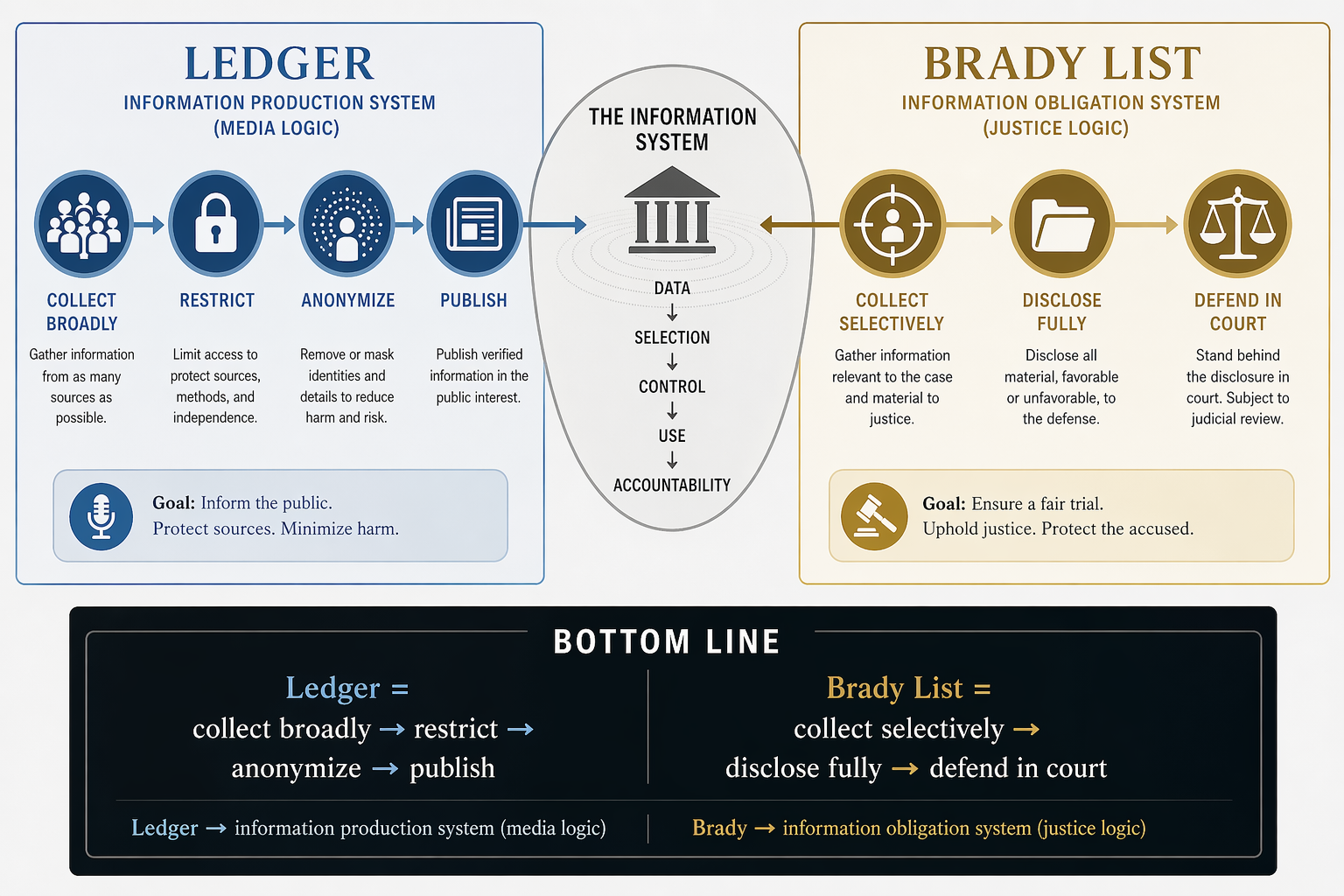
In the United States, a Brady list (sometimes "Brady-Giglio list") is the registry a prosecutor's office maintains of police officers whose testimony may be impeachable in court — officers with sustained findings of dishonesty, misconduct, bias, or other credibility-undermining events. The lists originate from Brady v. Maryland (1963) and Giglio v. United States (1972), which together require the state to disclose to the defence any evidence that could affect a witness's credibility. Canada's analog is R. v. McNeil (2009 SCC 3): the Crown's duty extends to relevant officer-misconduct records. Neither Brady lists in the U.S. nor McNeil lists in Canada are structurally public — they live inside the justice system.
The Ledger is a parallel system, not a duplicate. Same underlying data about the same officers, but a completely different operating logic:
- Brady / McNeil = information-obligation system under justice logic. Collect selectively (only what prosecutors are required to disclose), disclose fully to the defence, defend the disclosure in court. Goal: fair trial, protect the accused.
- The Ledger = information-production system under media logic. Collect broadly (every public record, by design), restrict the dataset (publication lag, k-anonymity, publication-ban honour), anonymize (HMAC officer tokens, quarterly dates), publish. Goal: inform the public, protect sources, minimize harm.
These systems don't compete — they cover different societal functions. A Brady/McNeil list answers "is this officer's testimony credible in this case?". The Ledger answers "what patterns exist across all cases, across all forces, over time?". The first question belongs to the courtroom. The second belongs to journalism, research, and civil society. Canada has institutions answering the first (imperfectly, informally) and nothing answering the second.
This positioning has implications for funders:
- It's not "the Canadian Brady list." It's the piece that was missing alongside McNeil — the civil-society companion that the justice system never produced because that's not the justice system's job.
- It's not a name-and-shame tool. Names never surface publicly. Privacy protections are stricter than a Brady list requires, by design. That distinction matters for foundations wary of funding projects that could be used as harassment vectors.
- It scales where case-by-case disclosure doesn't. McNeil motions don't aggregate. A federated public archive does, automatically, across 200+ agencies.
- Vetted access for the justice-logic use case is on the roadmap. SPEC §12's researcher tier (Year 2 scope) provides audited access to the names-retaining archive for defence counsel, legal-aid workers, and academic researchers under institutional letterhead — the bridge between the media-logic public surface and the justice-logic use case, without collapsing the two.
The problem this addresses
Canadian police-accountability data is structurally fragmented:
- 30+ oversight bodies across federal, provincial, First Nations, and specialty jurisdictions — each with its own publishing cadence, URL structure, disclosure culture, and willingness to keep older records online.
- Historical records vanish. When an oversight body is dissolved or reorganized, its archives often move behind a new agency's website, and some quietly disappear. The Ontario Civilian Police Commission's 2024 dissolution, the ASIRT → PRC Alberta transition (2025-12-01), the OIPRD → LECA rename (2024-04-01) all created purge-candidate windows. There is currently no systematic Canadian watchdog for this.
- Cross-force officer history is invisible. When an officer moves between forces — Saskatoon to Regina, RCMP contract to municipal — their disciplinary history stays with the prior force's records. A researcher or journalist would need to file FOI at every agency and correlate by hand. The Ledger's HMAC-token view surfaces the same officer across agencies automatically.
- The numerical picture doesn't exist. No public aggregate answers "what percentage of custody-injury complaints result in charges" across all of Canada.
The status-quo workflow — individual reporters filing FOI per force — scales to investigative features, not to systemic accountability. The Ledger is the missing infrastructure.
What the grant unlocks in Year 1
The seed funds an editor + half-time developer. With those two roles, Year 1 delivers:
Year 1 budget
| Line item | Annual | Notes |
|---|---|---|
| Managing editor (FTE) | $110,000 | Adapter-maintenance oversight, redaction-template review, corrections triage, federation partnerships. |
| Editor benefits + employer costs | $22,000 | ~20% loading. |
| Half-time developer (contract) | $70,000 | Tier-A adapter work, schema evolution, purge-detector tuning, dataset QA. |
| Legal (incorporation, policies, SLAPP retainer) | $25,000 | One-time Year 1 heavy; ~$8k/yr after. |
| Server + infrastructure | $3,000 | Hetzner box + domain + backup storage. Largely fixed-cost. |
| LLM API budget (Anthropic, capped) | $6,000 | ~$500/month ceiling. SPEC §15.2 daily token cap enforces this. |
| Editorial + travel (source verification) | $15,000 | A handful of in-person visits to oversight-body archives for historical-record verification. |
| Reserves + runway buffer | $99,000 | ~3 months of steady-state ops held as contingency. |
| Total | $350,000 | Year 1 |
Year 2 onward drops to ~$210,000/year — legal amortizes, reserves already funded, operations stable. The codebase itself requires no capital investment (it exists and is under source control).
Why fund now, not later
- The infrastructure exists. Most "journalism infrastructure" grants fund building; this one funds operating something already built. Grant dollar goes 3× further.
- Early-window purges are irretrievable. Every month the project isn't editorially staffed, records can disappear that no future resourcing can reconstruct. The Thunder Bay Police 2018 Sinclair review, the ASIRT pre-2025-12-01 archive, the OCPC pre-2024 archive — every one is at elevated purge risk right now.
- Federation partners are receptive. Tracking (In)justice (U.S. state-level), CBC Deadly Force (Canadian, force-level), Big Local News (Stanford, cross-border) all operate openly and have indicated (in public forums) that a Canadian federation partner would be welcome.
- Low-risk capital. If Year 1 doesn't deliver, the CC-BY public data and the open-source codebase remain as public goods. Nothing is locked in a proprietary vault. Even a funded-and-failed version yields positive ecosystem value.
Target funders
Canadian journalism infrastructure
- Local Journalism Initiative (admin via CAJ / APF / NPF / QCNA) — funds journalism positions directly, ~$50k/yr each. Could cover the editor line.
- Inspirit Foundation — social-justice focus, $5k–$100k typical, Canadian-indie-media-friendly.
- McConnell Foundation — democracy + civic infrastructure, $50k–$250k typical.
- Canadian Journalism Foundation — innovation grants.
Civic-tech + open-data
- Mozilla Foundation — data sovereignty / civic tech.
- Ford Foundation — civil-society infrastructure, cross-border eligible.
- Knight Foundation — journalism innovation, cross-border eligible.
- Open Society Foundations — democratic practice / accountability.
Platform / tech-company journalism programs
- Google News Initiative — data & reporting infrastructure.
- Meta Journalism Project — remaining programs post-2024 wind-down.
Academic partnerships (co-funded)
- University of Toronto Centre for Criminology — institutional hosting + research-chair co-appointment.
- SFU School of Criminology — western-Canada lens + BC focus.
- McGill / Concordia — Quebec oversight bodies (bei-qc, cdpq) sit in their backyard.
Team + capacity
Founding technical team: independent Canadian civic-tech developer with prior public-interest infrastructure experience. Built the full stack in the project's initial scaffolding phase and committed to stewarding it into operational phase under a publishing partner's fiscal sponsorship. References available on request.
To be hired with grant funding:
- Managing editor — journalism background, ideally with FOI / policing-beat experience. Leads adapter-maintenance, redaction-template review, corrections triage, federation partnerships.
- Half-time developer (contract) — Python + TypeScript comfortable, takes over Tier-A adapter work and schema evolution.
Advisory — to be recruited at announcement: 3–4 seats from Canadian journalism + criminology + data-journalism communities.
What success looks like (12-month targets)
- 200+ agencies seeded and crawling.
- 15+ hand-tuned extractors.
- ~1,500 incidents on the public surface.
- A first documented purge event flagged editorially and republished with Wayback / IPFS evidence.
- At least one federation partner live (Tracking (In)justice, CBC Deadly Force, or Big Local News).
- 4+ substantive accountability stories by partner newsrooms that credit the archive.
- CC-BY 4.0 bulk-download mirrored and forked by at least two third parties.
- Year 2 funding path in view — at least one renewal commitment from a Year 1 funder + one new anchor.
Sustainability beyond Year 1
Three plausible long-term models:
- Diversified grants (most likely). Year 2 at ~$210k is within reach of 3–4 mid-size annual renewals plus a rotating anchor. Requires ongoing development work but not the Year 1 build-out.
- Academic institutional host. A criminology or journalism school takes over hosting, fiscal, and at least half the editor salary. Editorial independence preserved via MoU.
- Co-branded newsroom partnership. A Canadian newsroom (Globe, CBC, Star, The Breach scaled up, or a hypothetical consortium) becomes the editorial home under their existing editorial governance, with the Ledger as a named standing column / data desk.
All three paths preserve the CC-BY public-data commitment. None paywall.
Next step for a program officer
30-minute call to scope fit with your foundation's current portfolio. Bring the most recent policing-accountability story your grantees covered — we'll show what the same question looks like against the live archive. Follow-up with a full proposal in your foundation's standard format within 10 days of the call.
Intake via policedata.ca/about.
Figures current as of April 2026 first production deploy. All numbers conservative — the archive has been operational for days, not months, and the Year 1 targets assume the editorial capacity the grant would fund. Public data release under Creative Commons BY 4.0. Private archive access governed by PIPEDA journalism exemption; officer names never surface on public URLs.
Prospectus v1.0 · companion newsroom acquisition brief · source in docs/BROCHURE.md